

Guide to U.S. Sacagawea Dollars
The Sacagawea Dollar was launched by the United States Mint in the year 2000 with great fanfare. The new dollar coins retained the small-size of the previous series but carried a newly developed golden color. Sacagawea and child were featured on the obverse with a soaring eagle on the reverse. In the very first year of the series, a number of intriguing issues were created including a version struck in 22 karat gold, a pattern with a prototype reverse, presentation coins with a special finish, and a mule error. The series would continue until 2008 and then transition to the Native American Dollar, which featured the Sacagawea obverse design paired with rotating reverse designs.
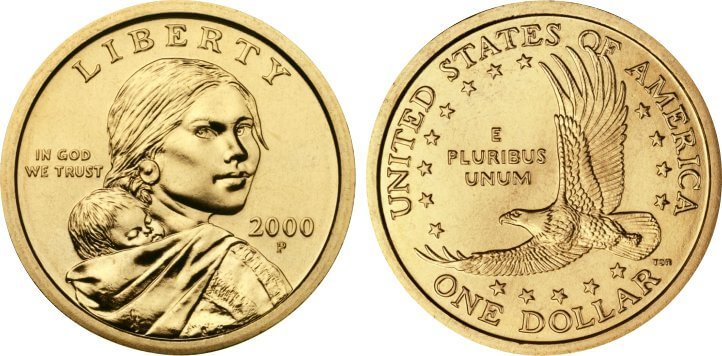
Despite their initial unpopularity, the previous Susan B. Anthony Dollar series had begun to find use within vending machines and mass transit systems. With supplies dwindling, Congress introduced legislation to authorize a new series of small-sized dollar coins. On December 1, 1997, the United States $1 Coin Act of 1997 was passed as a section of the 50 States Commemorative Coin Program Act. The legislation called for the new dollar coins to be “golden in color, have a distinctive edge, have tactile and visual features that make the denomination of the coin readily discernible.”
Legislation
The legislation did not provide specific guidance for the design of the new series, so the Secretary of the Treasury created the nine-member Dollar Coin Design Advisory Committee. After reviewing 17 design concepts, the Committee recommend Sacagawea as the subject of the coin. She was the Shoshone Native American woman who assisted Lewis and Clark on their historic expedition. The United States Mint invited 23 artists to submit designs featuring an image of Sacagawea on the obverse and an eagle on the reverse to symbolize peace and freedom. After the designs were reviewed by representatives of the Native American community, numismatists, artists, historians, members of Congress, the Commission of Fine Arts, and members of the public through polls and focus groups, the Secretary of the Treasury made the final decision.
Obverse Design
The obverse design was created by American sculptor Glenna Goodacre. The design features Sacagawea in three-quarter profile, carrying her infant son Jean Baptiste Charbonneau on her back. Since no contemporary image of Sacagawea exists, Goodacre used a 22-year-old Shoshone woman named Randy’L He-Dow Teton as a model for the coin. The obverse inscriptions include “LIBERTY” above, “IN GOD WE TRUST” in the left field, and the date and mint mark in the right field.
Reverse Design
The reverse design was created by United States Mint Sculptor-Engraver Thomas D. Rogers, Sr. It features an eagle in flight encircled by 17 stars, representing each state in the Union at the time of the Lewis and Clark Expedition. The inscription “UNITED STATES OF AMERICA” appears above, with the denomination “ONE DOLLAR” below, and the motto “E PLURIBUS UNUM” in the left field above the eagle’s head.
The official first striking for the Sacagawea Dollar took place during a ceremony held on November 18, 1999. The coins would not be officially released for circulation until January 27, 2000. As provided under the authorizing legislation, the United States Mint engaged in a significant marketing program to promote awareness and use of the new dollar coins. This included television, radio, and print advertisements, as well as partnerships with Walmart and General Mills. A total of $100 million of the coins were sent to Walmart and Sam’s Club stores to pay out as change. General Mills released 10 million boxes of Cheerios cereal containing a 2000-dated Lincoln Cent, with one in every 2,000 boxes also containing a Sacagawea Dollar.
In anticipation of widespread usage for the new golden dollars, the United States Mint produced more than one billion pieces for the first year of issuance. The mintage level would fall by nearly 90% by the second year, and starting in 2002, production was confined to the quantity necessary to satisfy demand from coin collectors. The coins would be included within annual numismatic sets and also sold in bags and rolls at a premium to face value. After 2008, the series transitioned to the Native American Dollar series, which featured the same obverse portrait of Sacagawea paired with an annually rotating reverse design highlighting the contributions and accomplishments of Native Americans.